The transition is underway. Is your organisation positioned to capture it, or absorbing its cost?
Insights from my advisory desk.
On Europe's climate solutions, resilience funding and transition progress. Organized along the decision chain every one of my stakeholder travels:
SCAN → PRICE → DECIDE → FINANCE → DELIVER → GOVERN.
For clear audiences, each insight answers: is this your problem, what do the numbers say, and where it becomes work. By Dr. Sebastian Rath.
What you get here that generic advice doesn't give: deliverables, timelines and fees defined before work starts — so you know what you receive, when, and for what scope.
From Insights to Action
Insights that connect transition opportunities across capital and insurance markets, coming from live engagements.
As you embrace EU reforms, or address productive investment needs with financeable structures, securitzation or parametric alike — start with the one closest to your challenge — and see where your activities and our work overlap.
For three ways to engage:
Brand concept, in action
What Lighthouse Bay Solutions is set to support. And how this fits with solving your transition challenges.
WHAT we stand to achieve, with you:
LIGHT + HOUSE + BAY = SOLUTIONS
LIGHT: bringing the expertise that improves adaptation and resilience investments — across sectors, technology, finance and risk
HOUSE: embedding climate, carbon, and circularity into the businesses and infrastructure that must deliver it
BAY: guiding regional action, access to EU funding and adaptation finance, and carbon market mechanisms turning regional plans into budgets
SOLUTIONS: pairing decisions with deep tech, climate intelligence, and human judgement, so that boards decide with fewer barriers and clearer stakes
HOW our decision-chain enables your transition challenges:
SCAN → PRICE → DECIDE → FINANCE → DELIVER → GOVERN
SCAN IT: Unlike reading the news, scanning for your next postion in funding transition progress means knowing which change and action you must drive next — your moves that matter, to decisions you have pending.
PRICE IT: Number stay yours. We bring a pricing partner's view — lived experience connecting finance, investment, risk and insurance — so the price you set rests on firm evidence.
DECIDE IT: Every transition is a chain of decisions. We acknowledge this centrality for your end-to-end, and help you make, connect, and defend them, with decision-ready insights from strategy to outcomes.
FINANCE IT: Alongside you, as retained decision partner. Without committing own capital or taking a financing role, adding indepentent perspectives to your structuring conversation and balance sheet.
DELIVER IT: Executing with you, for approvals becoming progress, as delivery embeds adaptation and resilience — and re-risks each of your transition investments.
GOVERN IT: Serving long-term progress, where delivering a transition raises genuine governance questions. Answered in a fractional or non-executive mandate.
Insights from Lighthouse Bay Solutions
A series of ongoing conversations, on climate risk, transition finance and resilience. Illustrating the kind of conversations worth having now. Get in touch to take them further.
OUR TRANSITION DECISION CHAIN: SCAN → PRICE → DECIDE → FINANCE → DELIVER → GOVERN.
Each of your climate and transition finance decisions sits somewhere on our chain.
Find your place, and your next move.
Whatever your stage, the work starts the same way: a named decision, a defined deliverable — dates and fees agreed before work starts.
Whether you navigate our Insights with your bespoke mapping, or simply read on: You'll find all our Insights here below...
I'm on a board...
YOUR STAGES: SCAN & GOVERN. Scanning what calls your next decisions, and the oversight needed for next quartler's progress. Start with:
YOUR SERVICES: Board & NED Support · Transition Unlock · Retained Decision Partner · Bespoke Support
I'm a CFO...
YOUR STAGES: PRICE & FINANCE. What the exposure costs, and how the plan gets funded. Start with:
I invest...
YOUR STATES: SCAN & FINANCE. Where the transition is heading, and where the opportunity sits. Start with:
I run a programme...
Your stage: DELIVER. Approval was the beginning, not the end. Start with:
YOUR FIRST INSIGHT: EU climate funds flow, execution is the new gap (09)
YOUR SERVICE: Transition Unlock (focus on 90-Day Execution Sprints)
Dr. Sebastian Rath · published 02 October 2026 · 3 min read
SCAN IT · For: boards in industry and infrastructure; investors and allocators.
The €1 trillion decade: how boards capture Europe's climate capital
In short: As of January 2027, the rules of the game change in Europe's climate economy: the EIB Group's new PATH 2 framework takes effect, simplifying climate financing just as its Climate Bank Roadmap Phase 2 steers at least €1 trillion into green investment this decade. When the EIB Group alone commits at that scale, capital stops being the constraint. Attention shifts to what boards actually control: allocation, alignment, and speed to financial close.
Is this your problem?
- Your 2027 planning still treats climate capital as a policy story, not a standing allocation agenda item.
- You could not say which projects in your pipeline could realistically reach financial close within a two-year funding window.
- The EU is no longer just funding projects; it is creating ecosystems where policy, finance and innovation converge. And in such an ecosystem, first movers set the terms latecomers trade on. You are catching-up about them.
What the numbers say: EIB Group: at least €1 trillion in green investment this decade (Climate Bank Roadmap Phase 2), a €30bn adaptation finance target for 2026–2030, and a record €100bn signed in 2025 alone. InvestEU Fund: at least €372bn in additional investment to be mobilised by 2027. Innovation Fund: a fresh wave of calls opens December 2026 — including two new calls dedicated to small and medium-sized enterprises and the maritime sector — with funded projects expected to reach financial close within two years. The endorsed Social Climate Plans (Lithuania €884m, Malta €60.6m) tie spending to financial and social returns.
How peers solve this:
- Public money at historic scale — EIB, InvestEU, Innovation Fund — can sit below yours, if you are structured for it before the calls open.
- speed and clarity are becoming the currency of transition leadership: two-year close windows reward allocation decisions.
- CEOs build relevance; CFOs safeguard resilience. When their courses collide, progress must not grind to a halt — mastering that alignment is the structural governance challenge of 2027.
Where this becomes work: The radar, and the decision it should change, for your 2027 allocation agenda. Capital & Risk maps where the money moves and what fits your balance sheet; Board & NED Support frames the oversight. Deliverable, dates and fees agreed before work starts.
1 Trillion Decade
From the advisory desk, not the newsroom.
Before any work begins, you know what you receive, when, and for what scope.
A deliverable you own, serving a decision you've named.
Illustration, not advice: what fits you depends on your sector, region and balance sheet.
Scope is defined before signature . See the disclaimer.
Insight-10
From the advisory desk, not the newsroom.
Before any work begins, you know what you receive, when, and for what scope.
A deliverable you own, serving a decision you've named.
Illustration, not advice: what fits you depends on your sector, region and balance sheet.
Scope is defined before signature . See the disclaimer
Dr. Sebastian Rath · published 17 Sept 2026 · 4 min read
DECIDE IT · For: CEOs, CFOs and nomination committees.
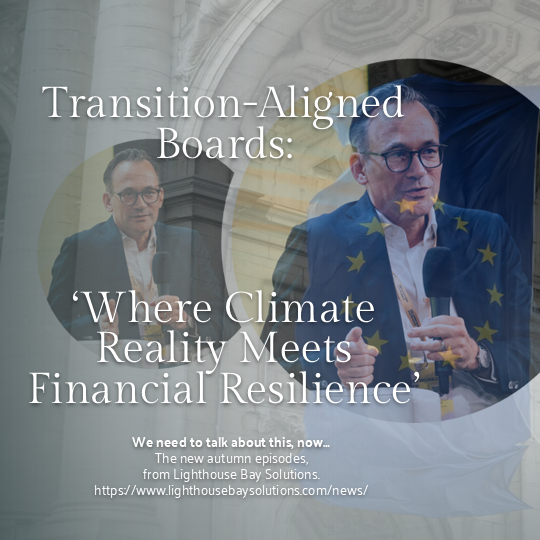
Transition-aligned boards: as CEO and CFO, working on climate
In short: The moment your transition progress stalls often builds quiet tension between two people wanting the same outcome, while evaluating different risks. As CEO, you navigate the horizon: where do we need to go to stay relevant? As CFO, you steer the balance sheet: what happens if costs spiral, or the business model fractures? Both perspectives are complementary lenses on the same challenge. Yet when they collide in the boardroom, conversations often grind to a halt, just as transition and implementation need acceleration.
Is this your problem?
- As CEO your approval gives direction for the organisation's place in a changing world; and with your CFO, exposures, liabilities and the ability to absorb shocks are being addressed— though not really on climate, energy and large societal transitions we are experiencing now.
- When courses collide in your boardroom, progress grinds to a halt, yet implementation needs speed with acceleration for decisions ahead.
- Your board still discusses "can we afford the transition?" — not "what is the added cost of delays and inaction, and how resilient are our choices as today's assumptions shift in real time?"
What the numbers say: What the numbers say: Europe's 2026 State of the Union makes the shift impossible to ignore: climate resilience is now a live question of economic security — heat stress on supply chains, water scarcity in operations, wildfire risk to assets, and the cascading costs of inaction. These are no longer environmental footnotes, but strategic variables, belonging in capital allocation choices. Regional Climate Resilience Frameworks are rolling out across Europe; an EU-wide climate insurance alliance is called together with urban adaptation and cooling as mission-critical efforts. For nomination committees: prioritise directors who will bridge your vision–scrutiny alignment to turn transitions into competitive advantages; those that don't risk unmanaged exposure and value erosion.
How peers solve this: What you need is rarely more persuasion, more targets, or another presentation on climate urgency. In my experience, boards resolve this by asking:
- "What must the board know before capital is committed?" — structural alignment to resolve disconnects, and evidence that materially informs the CFO's decisions.
- "Can we move the risk instead of holding it?" — clear risk choices: what is being transferred, retained, or mitigated — inside a framework that navigates contested assumptions.
- "Who steers our irreversible commitments?" — decision calling clarity on options, owners and skills; as capital allocation balances strategic ambition with financial rigour.
Where this becomes work: I have sat on both sides of such discussions, internally and externally. This is the practical work of transition governance, and where Board & NED Support acts: strengthening frameworks for critical assumptions, clear risk choices, making decision execution clearer, simpler and defensible. Deliverable, dates and fees agreed before work starts.
Dr. Sebastian Rath · published 16 Sept 2026 · 3 min read
DELIVER IT · For: programme and project owners with approved funding.
EU climate funding is flowing — execution is the new gap
In short: Transition plans aren't on most homepages of Europe's transitioning industries. Yet look at the funding flows, and you can anticipate the frontier of progress: the Innovation Fund has awarded over 260 projects; its 2026 Heat Auction selected 65 projects for €400M in grants. It's not a technology problem. Nor, mostly, a capital problem: the EIB Group targets €100 billion in new financing for 2026. Currently, it's primarily an execution and conversion challenge: approval ≠ action ≠ impact.
Is this your problem?
- Your project is approved, ownership isn't lined up, teams are still figuring things out post-approval.
- Your funding clock ticks: financial close within 2–2.5 years and operation within 4–5 years, depending on the call — or you risk losing it.
- Your transition has been "pending" for over a quarter.
What the numbers say: The Innovation Fund: over 260 projects awarded, with new grant agreements still being signed in mid-2026. The 2026 Heat Auction selected 65 projects (€400M in grants), with agreements expected in H2 2026 and final lists in Q4 2026 — from 85 applications requesting €1.4B, over three times the budget. All must reach financial close within 2–2.5 years and operation within 4–5 years, or risk losing funding. The EIB Group targets €100 billion in new financing for 2026, focusing on energy autonomy, innovation, and strategic industries. And where the money lands is simple and transparent to check: the Innovation Fund dashboard shows ongoing projects at regional scale, NUTS 3 — answering the question citizens ask first: where, in my area of Europe, is this progress getting funded?
How peers solve this: In practice, owners of approved funding solve this by asking:
- "Which three decisions are blocking capital release?" — working sessions with your board to surface them, in time to act.
- "Does the current plan survive investor due diligence?" — a straight answer, before the timeline starts costing money.
- "Who takes ownership after approval?" — structured progress, e.g. against the Innovation Fund's tight timelines, so approval becomes action, and action becomes impact.
Where this becomes work: If your transition has been "pending" for over a quarter, the real question isn't whether it's still the right plan. It's whether you're ready for your 2026 execution sprint. The 90-Day Execution Sprint brings the working sessions with your board: the three decisions blocking capital release, and a straight answer on whether your current plan survives investor due diligence — not another consulting report, so your plans join those getting to funding, progress, and delivery. Dates and fees agreed before work starts.
Insight-09
From the advisory desk, not the newsroom.
Before any work begins, you know what you receive, when, and for what scope.
A deliverable you own, serving a decision you've named.
Illustration, not advice: what fits you depends on your sector, region and balance sheet.
Scope is defined before signature . See the disclaimer.
Summer Insight 08/2026
Featured on illuminem
From the advisory desk, not the newsroom.
Before any work begins, you know what you receive, when, and for what scope.
A deliverable you own, serving a decision you've named.
Illustration, not advice: what fits you depends on your sector, region and balance sheet.
Scope is defined before signature . See the disclaimer
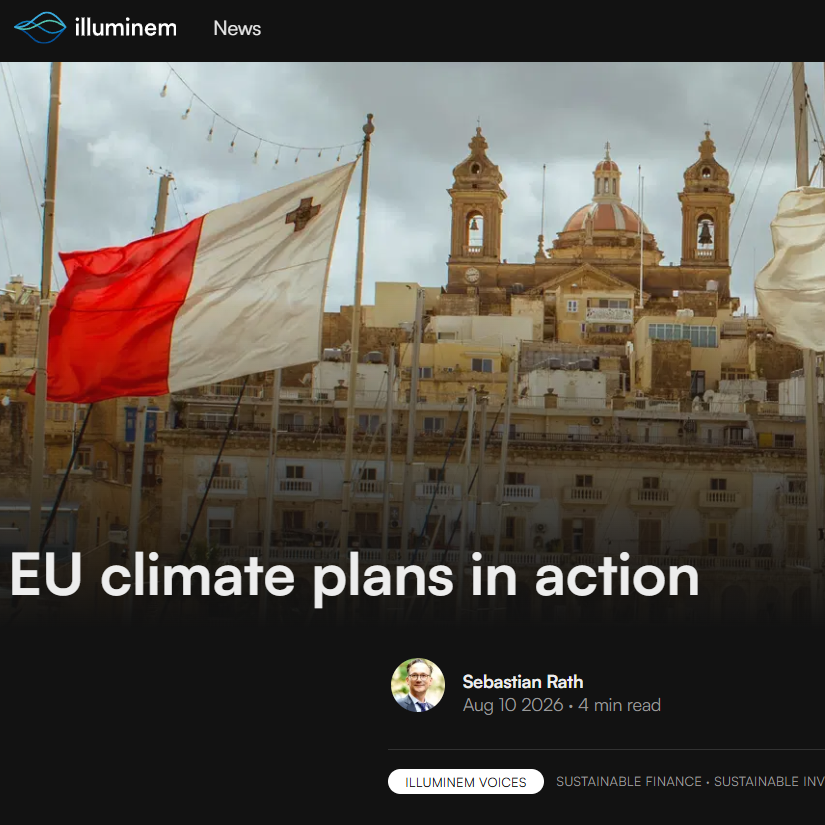
Dr. Sebastian Rath · published 10 Aug 2026 · 5 min read
FINANCE IT · For: regional and public partners; social-infrastructure investors.
Social Climate Plans: how Malta and Lithuania turn EU funds into results
In short: The EU's Social Climate Fund bridges the gap from climate action to social fairness — started in 2026, designed to cushion the impact of transition costs on those who may struggle the most, before the effects of ETS2 become reality. It scales to €86.7 billion over 2026 to 2032, financed fully by the EU Emission Trading Systems. The first national plans emerged, tailored to regional transition pressure points — and they show how EU funds become results.
Is this your problem?
- ETS2 puts a price on carbon emissions. From buildings, road transport and small industries. And your region's buffering plan may link to your budget lines.
- You could not name your regional plan's beneficiaries, their number, or timelines to engage.
- In your plan, fairness is a communications topic. Not a financed, targeted intervention with measurable outcomes.
What the numbers say: The Social Climate Fund scales to €86.7 billion over 2026–2032, deploying ETS and ETS2 revenues towards vulnerable households, small businesses, and transport users. Lithuania's plan amounts to €884.2 million, €662.9 million from the fund — for 42,000 vulnerable households in energy-inefficient housing, 74,000 vulnerable transport users in rural areas, and 3,200 vulnerable micro-enterprises in the transport sector, with the clear mission to remove this vulnerability by 2032. Malta's plan supports vulnerable households, transport users and micro-enterprises: 236 social apartments, 1,431 energy-vulnerable households, 30,000 targeted transport users, 865 micro-enterprises. Latvia (€620m: 10,000 households, 83,000 transport users, 45 kt CO₂e saved) and Sweden (over €530m: around 115,500 rural households) follow the same pattern.
How peers solve this: In practice, regional and public partners turn EU funds into results by asking:
- "Who exactly is vulnerable, where, and how can multiple interventions combined deliver scaled improvements?" — with credible plans naming by when vulnerability are removed.
- "What does this plan deliver beyond decarbonization?" — fairness, affordability and resilience: climate impacts well beyond decarbonization, across Europe's struggling regions and demographics.
- "Does the plan de-risk, or only distribute?" — my advice: it would not suffice if climate shocks, price volatility and uninsured losses continue to erode household security and business continuity; resilience policy works on de-risking principles, next to the traditional role of insurance markets.
Where this becomes work: Regional Resilience works with regional and public partners on the conversion the plans demand: EU funds into targeted interventions — named beneficiaries, leveraged finance, measurable outcomes that remove vulnerability rather than manage it. Alongside you and your counterparts; the structure and engagement conversation are informed by us, each funding choices stays yours. Deliverable, dates and fees agreed before work starts.
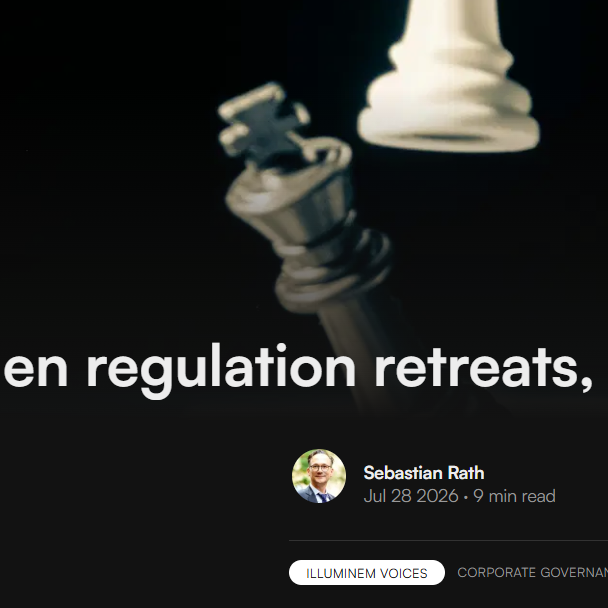
Dr. Sebastian Rath · published 28 Jul 2026 · 6 min read
GOVERN IT · For: audit, risk and sustainability committees.
When regulation retreats, the risk doesn't
In short: On 18 March 2026, the EU's Omnibus I simplification package took effect. Among its most consequential changes: the standalone legal obligation under CS3D for large companies to adopt and implement a Paris-aligned climate transition plan was deleted outright; scope narrowed from roughly 13,000 to 6,000 companies, with a single compliance date moved to 2029. Read narrowly, this is a compliance story. Read at board level, it is a different story: Omnibus loosened the disclosure architecture. It did nothing to the underlying exposure.
Is this your problem?
- Your committee agenda treated 2029 as the work plan — and now that no one has to sign off on a transition plan, ownership has diffused across functions that each assume someone else is tracking it.
- Your physical and adaptation exposure is assessed exactly as far as disclosure requires — while a company just below the CS3D threshold carries essentially the same exposure as one just above it.
- Carbon market exposure was riding the transition plan's coattails: CBAM cost pass-through, ETS price trajectories and removals procurement are not on your strategy agenda in their own right.
What the numbers say: Physical risk was never contingent on Brussels: Swiss Re's sigma reports show natural catastrophe losses exceeding $100 billion annually in 8 of the last 10 years; Munich Re's 2025 analysis found 72% of corporate insurance claims now involve climate-related physical risks, up from 45% in 2020. Adaptation finance reached $63 billion in 2023 (Climate Policy Initiative) — just 10% of total climate finance — and only 40% of global catastrophe losses were insured (Swiss Re). Carbon markets: EU ETS prices have tripled since 2020, from ~€25 to ~€90/tonne in early 2026; CBAM's financial obligations started in 2026; the voluntary market traded ~500 million tonnes in 2024, with high-integrity removals exceeding $200/tonne. And the supervisors are not waiting: the ECB's 2025 climate stress test requires banks to model physical risk on credit portfolios; EIOPA's 2026 guidelines make climate risk material under Solvency II; the EBA found 60% of EU regional banks had not integrated climate risk into their credit models, despite 78% acknowledging material exposure.
How peers solve this: For audit, risk and sustainability committees, the right response to Omnibus is not to relax climate oversight, but to re-anchor it in economics and exposure rather than disclosure scope. Three questions structure that conversation for your next quarter:
- "Is transition risk still owned by someone, now that no one has to sign off on it?" — statutory duties concentrate ownership almost by accident; broaden the duty and ownership grows beyond silos.
- "Does our physical and adaptation exposure get assessed independently of what we're required to disclose?" — regulatory scope thresholds are a political outcome, not a risk boundary.
- "Is carbon market exposure priced into strategy now, or did it overly depend on the regulatory transition plan momentum?" — my feedback: CBAM is a pass-through, nor do ETS trajectories and removals markets pause because a due-diligence duty is being scaled back.
Where this becomes work: I spent years building catastrophe and climate risk models on the insurance and reinsurance side; the lesson that carries over is that physical risk pricing has always run ahead of regulation, not behind it. For those seeking structural governance support, and where nomination committees seek the right board or non-executive director as challenger, my advice is the following: for your long-term interest, and whether you now need a fractional or permanent support, its time to re-anchoring your committee's transition and climate oversight in economics and exposure. Some experience that an Asset Resilience review is the start for grounding shifting exposures that the committee owns. Deliverable, dates and fees agreed before work starts.
Summer Insight 07/2026
Featured on illuminem
From the advisory desk, not the newsroo,.
Before any work begins, you know what you receive, when, and for what scope.
A deliverable you own, serving a decision you've named.
Illustration, not advice: what fits you depends on your sector, region and balance sheet.
Scope is defined before signature . See the disclaimer.
Insight-08
The final part of our 8 pre-summer insights in 2026
From the advisory desk, not the newsroom.
Before any work begins, you know what you receive, when, and for what scope.
A deliverable you own, serving a decision you've named.
Illustration, not advice: what fits you depends on your sector, region and balance sheet.
Scope is defined before signature . See the disclaimer
Dr. Sebastian Rath · published 16 Jun 2026 · 4 min read
FINANCE IT · For: investors and corporates positioning 2026–27.
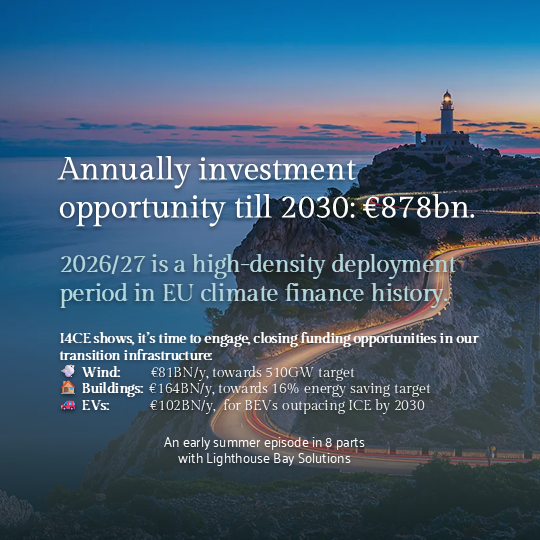
Europe's €344bn climate investment gap: where the opportunity sits
In short: I4CE's 2026 data: €534bn invested in 2025, €878bn a year needed to hit 2030 targets — a €344bn annual deficit, and it's growing. While capital is ready, gaps in execution persist. An uneasy position, especially since 2026–2027 is a defining period, with the EU's highest-density deployment window in history.
Is this your problem?
- You may quote the €344bn figure, without naming the three leading gaps that your own pipeline addresses: wind, buildings or EVs.
- Your transition plan isn't investment-grade yet: ambitions are in the deck, awaiting better geopolitical clarity, whist structures don't materialize in your funding conversations.
- Your 2027 agenda still treats the gap as a policy headline. Whilst the deployment window ahead is the densest in EU history.
What the numbers say: I4CE 2026: €534bn invested in 2025 against €878bn/year needed. A €344bn annual deficit, that's growing. Three leading gaps, as we continue building our transition infrastructures: wind, €81bn/year short, with the 510GW target at risk; buildings, €164bn/year, against 16% energy savings by 2030; EVs, €102bn/year, with BEVs needing to outpace ICE by 2030. By now we've covered 8 weeks of signals : physical risk, adaptation, transition plans, industrial decarbonisation, clean energy, regions, climate data — for every signal leading to actions here.
How peers solve this: As capital got ready; structure became the bottleneck. Boards, CFOs and funds positioning for 2026–27 ask:
- "Which of the three gaps do we sit in?" — wind, buildings or EVs: each shortfall closes through different structures, and capital positions against structure. Not sentiment.
- "Is our plan investment-grade yet?" — the honest question behind the €344bn: ambition is common; investment-grade execution is what capital management needs.
- "What are we structuring next?" — the defining-period question: in the highest-density deployment window in EU history, the capital moves to those building the structures.
Where this becomes work: This is the ground Capital & Risk works: where the €344bn sits against your sector, and what your plan needs to become investment-grade — alongside you and your counterparts. Our deep expertise. We commit no own capital and take no financing role: the structure conversation is ours, the balance sheet stays yours. Deliverable, dates and fees agreed before work starts.
Dr. Sebastian Rath · published 09 Jun 2026 · updated 12 Oct 2026 · 4 min read
PRICE IT · For: PE and infrastructure funds; risk officers.
Digital twins and asset-level climate data: premium or penalty?
In short: The EU's Destination Earth doesn't just improve climate models — it makes them more asset-specific. Since its operational launch in June 2025, this kilometre-scale digital twin delivers real-time, asset-level climate intelligence for ports, pipelines and power grids, replacing regional averages with continuous near-real-time, physics-based risk signals. This isn't about better data. It's about what becomes investable, and what doesn't. Assets with quantifiable physical risk will trade at a premium; those in the uncertainty penalty box face higher financing costs, long before impairments appear.
Is this your problem?
- Your physical risk assessment still answers "is this region exposed to flood risk?" — while competitors query the probability-weighted NPV impact of flood events on the specific asset, in 2027, 2030 and 2035.
- Assets you cannot evidence are drifting into the uncertainty penalty box: higher financing costs, long before impairments appear.
- Your infrastructure, financing and insurance teams are still working in silos — while the market starts acting on live climate intelligence.
What the numbers say: Southern European assets are repricing 3–5× faster than Northern ones — invisible in regional-average models. EIOPA, with EUSPA, has endorsed the insurance case for digital twins and live Earth observation: insurers will price off this data. The gap between firms integrating live climate intelligence and those running static scenarios is widening fast — for PE and infrastructure funds, a competitive moat, or an existential risk.
How peers solve this:
- "Can we decide on live data instead of older model scenarios?" — for certain decision, km-scale resolution live information may not be used for flood modelling, yet once live gives strong signals to heat and drought clusters, a structural edge for timely decision management.
- "What efforts do lenders and insurers currently honor?" — quantifiable physical risk converts uncertainty into terms that your pricing conversation can translate and connect into upside.
- "Who does our tracking and monitoring, and how?" — governance, underwriting and risk frameworks that can act on live data at the speed of the market, not once a reporting cycle.
Where this becomes work: The number stays yours. The Exposure & Adaptation Review answers one question first: what's built on sound and weaker data basis, which assets trade at a premium, which sit in the penalty box. Scope and fees agreed before work starts.
Insight-07
From the advisory desk, not the newsroom.
Before any work begins, you know what you receive, when, and for what scope.
A deliverable you own, serving a decision you've named.
Illustration, not advice: what fits you depends on your sector, region and balance sheet.
Scope is defined before signature . See the disclaimer.
Insight-06
From the advisory desk, not the newsroom.
Before any work begins, you know what you receive, when, and for what scope.
A deliverable you own, serving a decision you've named.
Illustration, not advice: what fits you depends on your sector, region and balance sheet.
Scope is defined before signature . See the disclaimer
Dr. Sebastian Rath · published 02 June 2026 · 4 min read
FINANCE IT · For: regional development agencies, anchor investors and their partners.
Which European regions build credible transition investment ecosystems?
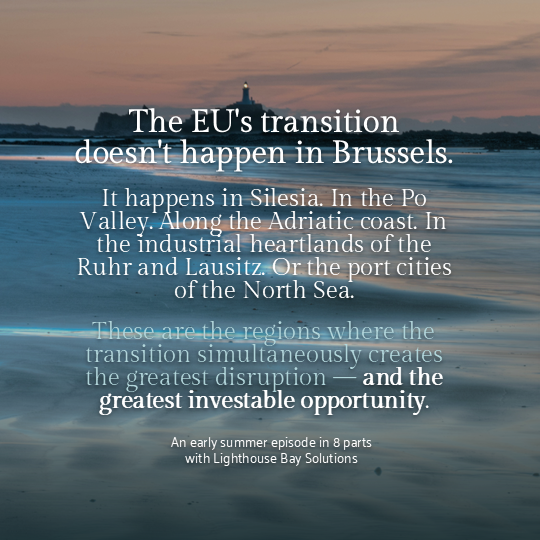
In short: The EU transition does not happen in Brussels. It happens in Silesia, in the Po Valley, along the Adriatic coast, in the industrial heartlands of the Ruhr and Lausitz, in the North Sea port cities. The EU has deployed €330 billion in Cohesion and Just Transition Funds for 2025–2030. The challenge in every one of these places: convert public funding into private investment ecosystems that actually retain economic value in the region rather than flowing elsewhere.
Is this your problem?
- Your region pitches a list of projects. Other regions capture private capital by pitching their replicable model of what their region will structurally become.
- Your stakeholders are not pre-aligned. And your investors price this fragmentation in slower deals and worse terms.
- €10bn of transition funds sits on your desk, and you could not name the one priority you would do first to attract private capital at scale.
What the numbers say: €330 billion deployed in Cohesion and Just Transition Funds for 2025–2030; Poland's Silesia and Germany's Lausitz are two large recipients, both working through the same conversion challenge. The regions capturing private capital have three things in common: a clear cross-sector investment thesis — not a list of projects, but a replicable model telling investors what the region is structurally becoming and why it is worth anchoring to; a public-private governance structure that reduces transaction costs — regions that pre-align their stakeholders close deals faster and on better terms; and lighthouse projects as proof points — the Mission on Adaptation has designated 47 lighthouse regions: not just policy labels, but trust signals that the institutional foundations are in place for capital to follow. The regions that move in the next 18 months will attract the anchor investments that define their economic identity for the next generation.
How peers solve this: In practice, regions and anchor investors expand trust and credibility by asking:
- "What are we structurally becoming?" — a cross-sector investment thesis, not a list of projects: a replicable model investors can anchor to.
- "Are we selling projects or ecosystems?" — North Sea ports are winning because they stopped selling projects and started selling ecosystems; pre-aligned governance is what turns the same assets into faster deals, on better terms.
- "What proves the foundations to the first anchor?" — lighthouse projects as trust signals: the 47 Mission on Adaptation regions show capital that the institutional foundations are in place.
Where this becomes work: Our focus on Regional Resilience and Funding Mapping works alongside regions and anchor investors on the conversion: the investment thesis, the pre-aligned governance, the lighthouse proof points that turn €330bn of public funding into private ecosystems that keep value in the region. The structured conversation support from us; the local funding and progress is for your stakeholders. Deliverable, dates and fees agreed before work starts.
Dr. Sebastian Rath · published 26 May 2026 · 4 min read
FINANCE IT · For: industrial strategists in hard-to-abate sectors.
REPowerEU, Decarbonization Bank, Innovation Fund: who steps up?
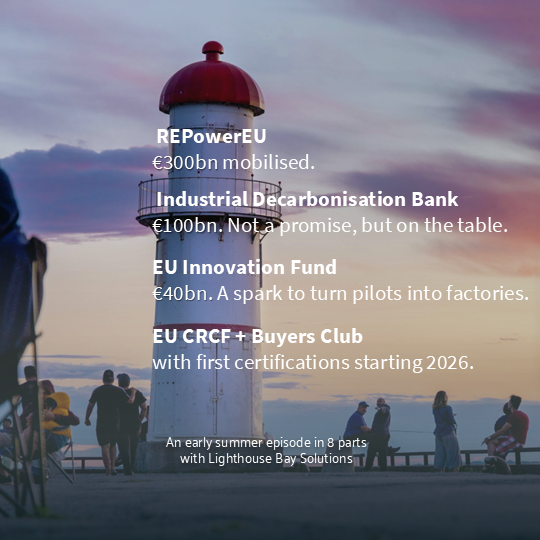
In short: Some revolutions aren't televised: those that built up slowly, partner by partner, tonne by tonne. The capital is on the table — REPowerEU's €300bn mobilised, the Industrial Decarbonisation Bank's €100bn, the Innovation Fund's €40bn as the spark turning pilots into factories, and the CRCF with the EU Buyers Club, first certifications starting now in 2026. This isn't about waiting for policy or technology. It's about who shows up.
Is this your problem?
- You track all four instruments, but hold no position in any: no offtake commitment, no consortium seat, no certification strategy.
- Your decarbonisation business case still waits for policy or technology. While the signposts increase, the capital positions, and the rules emerged.
- You could not say which instrument maps to your next industrial investment. Or who in your market has already taken a stake in future's progress in the last quarter."
What the numbers say: REPowerEU: €300bn mobilised; it's Europe's rallying cry to break free from fossil fuels and rebuild industry for the net-zero age. The Industrial Decarbonisation Bank: €100bn; it's not a promise, but capital on the table for those who step up. The EU Innovation Fund: €40bn as a spark turning pilots into factories, ideas into infrastructure. The CRCF and the EU Buyers Club: first certifications starting now in 2026; it's the market mechanism turning green premiums into greener profits. One region shows the stack working together: In the North Sea, REPowerEU powers offshore wind and the hydrogen backbone, the Decarbonisation Bank can bankroll green steel and ammonia clusters, the Innovation Fund stands to scale carbon capture at the ports, and the CRCF and EU Buyers Club can certify the first carbon removals.
How peers solve this: These calls are gathering assigned roles. In practice, industrial strategists step up by asking:
- "What role do we show up in?" — as companies committing to offtake, as consortia sharing the risk, with financiers bridging the gap, as buyers creating the demand. Each instrument in our stack needs all four roles filled.
- "Which instrument is our first move?" — mapping your next investment to the stack: REPowerEU for energy infrastructure, the Decarbonisation Bank for industrial clusters, the Innovation Fund for scaling, the CRCF for the green premium.
- "Who else needs to be in the room?" — a single-company strategy leaves the green premium uncovered; the biggest industrial transformation in history is built jointly, partner by partner, tonne by tonne.
Where this becomes work: This is where Capital & Risk, Financing & Risk Structure place your commitment as capital steps up, alongside you and your counterparts — public programmes, co-investors, buyers. We commit no own capital and take no financing role: the structure conversation is ours, the balance sheet stays yours. Deliverable, dates and fees agreed before work starts.
Insight-05
From the advisory desk, not the newsroom.
Before any work begins, you know what you receive, when, and for what scope.
A deliverable you own, serving a decision you've named.
Illustration, not advice: what fits you depends on your sector, region and balance sheet.
Scope is defined before signature . See the disclaimer.
Insight-04
From the advisory desk, not the newsroom.
Before any work begins, you know what you receive, when, and for what scope.
A deliverable you own, serving a decision you've named.
Illustration, not advice: what fits you depends on your sector, region and balance sheet.
Scope is defined before signature . See the disclaimer
Dr. Sebastian Rath · published 19 May 2026 · 5 min read
FINANCE IT · For: CFOs and their Transition Risk Partners.
The €104bn adaptation gap: pricing the cost of failing to adapt
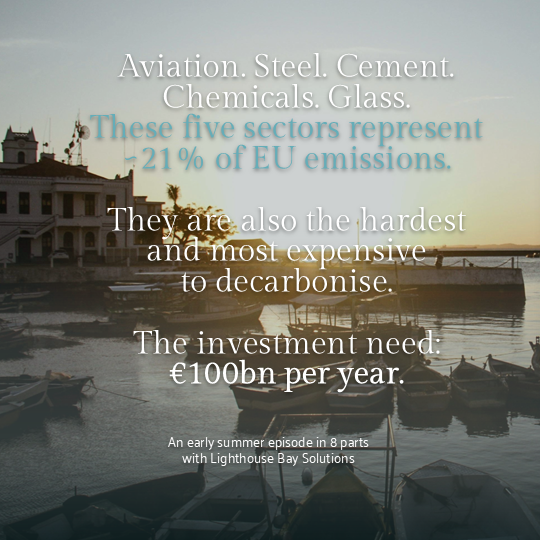
In short: Aviation. Steel. Cement. Chemicals. Glass. Five sectors, roughly 21% of EU emissions, an investment requirement of €100 billion per year. The gap is not a technology problem: green hydrogen, direct reduced iron, carbon capture and sustainable aviation fuels exist and are scaling now. What's typically missing is the financial architecture to move them.
Is this your problem?
- Your technology is proven, the business case solid, the internal mandate strong. And still, the deal isn't moving.
- Your board models the economics of inaction at yesterday's carbon prices — while ETS reform has moved carbon to €70–80 per tonne and CBAM is repricing competitive advantage around that same level.
- Public funding is earmarked for exactly your project: Innovation Fund, IPCEI mechanisms, Industrial Decarbonisation Bank. And yet, your team cannot reach it.
What the numbers say: Five sectors, roughly 21% of EU emissions; €100 billion per year of investment required. ETS reform has moved carbon to €70–80 per tonne; CBAM is repricing competitive advantage around that same level — the economics of inaction are deteriorating, faster than most industrial boards have modelled. Three gaps come up again and again: no long-term offtake anchor — without a buyer willing to carry the green premium for 10–15 years, the financing simply doesn't close; no consortium structure — the deals getting done are cross-sector, cross-border, with public co-investment built in from the start, not added later; and public funding that's there but unreachable.
How peers solve this: The diagnosis comes first — which of these is the one actually blocking your pipeline? In practice, industrial boards name it by asking:
- "Who carries the green premium for 10–15 years?" — no offtake anchor, no financing: the structure has to change what a commitment looks like before any lender signs.
- "Who moves first, who sets the terms, who carries the risk if a partner pulls out?" — the consortium question isn't just financial, it's political; the companies most likely to succeed are the ones that solve it first.
- "Why can't we reach capital earmarked for us?" — the funding exists at €100bn scale; what's missing is your puzzle piece, the contribution to the full project architecture, to connect.
Where this becomes work: The problem wasn't your plant, your finance or risk partner. It was everything around them. Capital & Risk — Financing & Risk Structure builds exactly that: engagement paths for offtake anchor, latest forums for consortium architecture, the direct route to public capital — alongside you and your counterparts, never in place of them. The structure conversation gets informed by us; the balance sheet stays yours. Deliverable, dates and fees agreed before work starts.
Dr. Sebastian Rath · published 12 May 2026 · updated 12 Oct 2026 · 4 min read
DECIDE IT · For: CFOs, treasurers and sustainability leads whose plan must survive lenders or shareholders.
Can a transition plan be underwritten? What lenders now require
In short: The EU slashed CSRD reporting from 50K to 5K companies. Many boards still think: phew. I think: uh-oh. The Omnibus didn't lower the bar — it narrowed the field to those who can chart it. What capital checks now is whether a plan can be underwritten: capex per phase, offtake reality, carbon details. If your transition plan can't be underwritten, it is not a plan. It is a presentation.
Is this your problem?
- Your "net-zero by 2040" deck is polished. But the financials are largely missing: no capex, few details on offtake agreements. A slide labelled "CSRD-ready" stands in their place.
- Your CFO could not walk a credit committee through the plan without the sustainability team translating.
- Your lender's questions — ETS phase-outs, CBAM-ready supply chains, CRCF-aligned removals — are answered with "in progress."
What the numbers say: CS3D kicks in July 2027; CBAM's first compliance deadline is September 2027. The 5K companies still in scope — and the smart ones using VSME — are the ones capital will back. From the desk: a mid-cap industrial's polished "net-zero by 2040" deck with no capex and few details on offtake agreements — and, in the same month, a European energy player closing a nine-figure transition loan on a roadmap tied to ETS phase-outs, CBAM-ready supply chains and a CRCF-aligned carbon removal strategy, because their lenders wanted a model, not just a PowerPoint.
How peers solve this:
- "What will a bank actually disburse against?" — capex, offtake and carbon detail, built to a lenders' model.
- "Can we stay lean and still credible?" — VSME-aligned evidence: compact, but carrying what capital asks.
- "Accelerating our progress and resilience?" — prepared plans that close financing rounds, owned by the entire leadership.
Where this becomes work: This is the ground the 14-Day Transition Unlock covers: where your plan stands, the three decisions that move it, and what a bank would actually disburse against. A named deliverable, dates and fees agreed before work starts.
Insight-03
From the advisory desk, not the newsroom.
Before any work begins, you know what you receive, when, and for what scope.
A deliverable you own, serving a decision you've named.
Illustration, not advice: what fits you depends on your sector, region and balance sheet.
Scope is defined before signature . See the disclaimer.
Insight-02
From the advisory desk, not the newsroom.
Before any work begins, you know what you receive, when, and for what scope.
A deliverable you own, serving a decision you've named.
Illustration, not advice: what fits you depends on your sector, region and balance sheet.
Scope is defined before signature . See the disclaimer
Dr. Sebastian Rath · published 05 May 2026 · updated 12 Oct 2026 · 3 min read
PRICE IT · For: infrastructure investors and owners of exposed assets.
The €104bn adaptation gap: pricing the cost of failing to adapt
In short: Everyone is talking about the cost of transition. Fewer are modelling the cost of failing to adapt. Those are different numbers, and investors need both. Europe will spend €70bn a year on adaptation; the EEA says it needs €174bn annually by 2050, just to keep three sectors resilient: agriculture, energy and transport. That €104bn annual gap isn't a funding crisis. It's an investment opportunity that lacks structure.
Is this your problem?
- You could not name one bankable adaptation asset in your pipeline reviews this year.
- You see the 4:1 return math, yet nothing you could underwrite: no credible offtakes, no de-risking mechanisms, no PPP frameworks that give institutional investors the certainty they need.
- Flood barriers, resilient water infrastructure, heat-proofed urban systems — you still file these as grants. They are not grants; they are investable assets.
What the numbers say: €70bn/year of current adaptation spend against €174bn/year needed by 2050 (EEA) — a €104bn annual gap. The EU's own analysis puts the benefit-cost ratio at 4:1 on average, as high as 10:1 for nature-based solutions in flood-prone catchments. The EU Adaptation Strategy, Mission on Adaptation and LIFE programme are creating a policy architecture that makes resilience finance viable at scale. The 2025–27 window is when first movers establish the structures that attract the next wave of capital.
How peers solve this:
- "Will a buyer commit, so we can borrow against it?" — credible offtakes and PPP frameworks turn carbon and nature-based solutions, or resilient infrastructure, into financeable cash flows.
- "Can someone else take the first loss?" — public de-risking can sit below corporate funds, where such co-financing structure can be agreed.
- "Can we decide on live data instead of old scenarios?" — asset-level resilience data turns avoided damages into figures a credit committee can work with.
Where this becomes work: What would need to be true for adaptation to appear in your investment pipeline? The Exposure & Adaptation Review names the exposures, the structures that make them bankable, and the 2025–27 window first movers act in. Scope and fees agreed before work starts.
Dr. Sebastian Rath · published 28 Apr 2026 · updated 12 Oct 2026 · 3 min read
PRICE IT · For: CFOs, audit and risk committees.
Is European climate risk priced into your balance sheet?
In short: A CFO asked me last month: "Is our exposure to European climate risk actually priced into our balance sheet?" The honest answer: almost certainly not. Europe is the fastest-warming continent. The EEA's 2024 risk monitor identifies 36 major physical risk clusters across EU member states — floods, droughts, heat stress, coastal erosion — with direct, quantifiable financial exposure. Many disclosures will only tell you more once risks have happened; stress tests and pricing should tell you what those will cost. And EU stress testing strengthens.
Is this your problem?
- Your board still treats physical risk as a 2030 problem, yet it is already material.
- Your exposure figures rest on global averages instead of asset-level data, hiding faster repricing.
- You treat insurance retreat as someone else's problem, whilst as insurers exit a market, the residual liability lands on your balance sheet.
What the numbers say: Southern European assets are repricing 3–5× faster than Northern ones. In such situations, it's key to realize that every €1 invested in adaptation returns about €4 in avoided damages. Meanwhile, gaps between disclosure and pricing can flip from being an initial data problem into a governance problem: that's why boards must receive climate risk information together with sustainability reports, financial risks, their probability distributions, confidence intervals and asset-level cost projections.
How peers solve this:
- "Can we decide on live data instead of old scenarios?" — updated asset-level exposures replaces earlier averages as the working basis for repricing, insurability and capex.
- "Can we move the risk instead of holding it?" — quantified the residual liability where insurers retreat; transfer what the market prices, retain what it doesn't.
- "As global temperatures rise, where does risk, quarter after quarter?" — climate and financial risks delivered to boards, with portfolio decisions attached.
Where this becomes work: The number stays yours. The Exposure & Adaptation Review checks that it rests on complete, asset-level evidence: named exposures, residual liabilities, and the decisions they change. Deliverable, dates and fees agreed before work starts.
Insight-01

From the advisory desk, not the newsroom.
Before any work begins, you know what you receive, when, and for what scope.
A deliverable you own, serving a decision you've named.
Illustration, not advice: what fits you depends on your sector, region and balance sheet.
Scope is defined before signature . See the disclaimer.
Thematic Foundations
Thought Leadership
Driving transition progress needs critical collaborations across sectors, decision-makers, and forward-thinking institutions. That is where Lighthouse Bay Solutions collaborates on thought leadership.
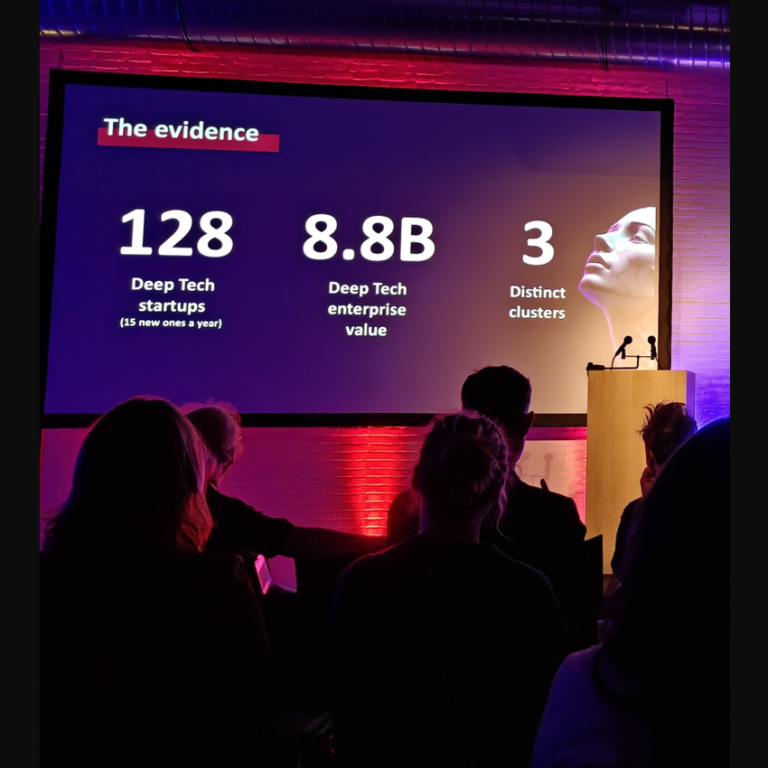
Deep Tech
(Light)
Enquire opportunities to collaborate across expert networks.
Climate Finance
(House)
For regional transformations, it takes all, bringing their best.

London Climate Week
(Bay)
Convening is at the heart and beginning of decisive progress choices.
Connect for the next conversations
Disclaimer: Information from these featured insights are illustrative of conversations at a certain point in time. Therefore, they cannot and do not contain legal, financial or business advice. They represent general informational and educational purposes only, and are not a substitute for professional advice. Accordingly, before taking any actions based upon such time-bound and limited information, you as reader are encouraged to engage in further consultation with Lighthouse Bay Solutions, appropriate peers and professionals. THE USE OR RELIANCE ON ANY INFORMATION CONTAINED ON THIS SITE IS AT YOUR OWN RESPONSIBILITY AND RISK.
Follow the Lighthouse Bay Solutions on LinkedIn, and our Thought-Leadership on illuminem.